Why Do Buyers Choose Strontium Fluoride?
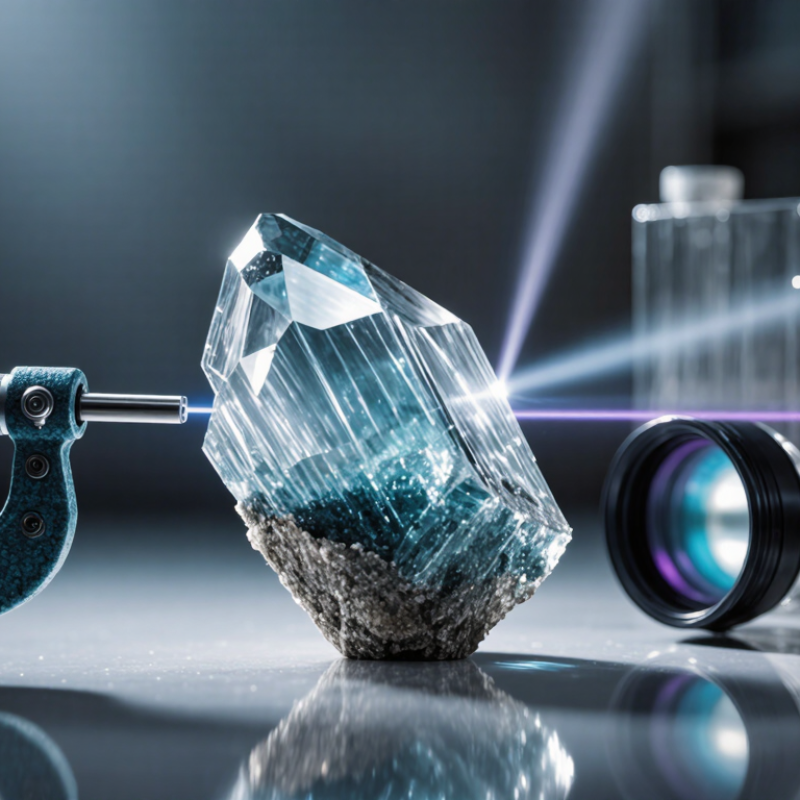
Why do buyers choose Strontium Fluoride? The answer often begins with the job a material must perform. This inorganic crystal has a fluorite structure and can transmit light across useful parts of the ultraviolet, visible, and infrared spectrum. Its optical behavior makes it relevant to selected windows, lenses, and other specialty components. It depends.
Buyers do not select a chemical formula alone. They compare purity, crystal quality, dimensions, surface finish, and transmission data against the needs of a specific design. A laboratory may request a small, carefully characterized sample, while an optical manufacturer may need consistent dimensions across multiple pieces. Supplier certificates and test methods matter. So do packaging and handling instructions, since contamination or surface damage can affect performance. Details matter.
Price is only one part of the decision. A lower-cost grade may not meet a demanding optical specification, while a premium grade may offer little benefit for a less sensitive application. Buyers should review technical data and confirm key specifications directly with the supplier, rather than assume every grade behaves identically. They should also consider compatibility with coatings, operating conditions, and the finished assembly. This trade-off deserves a closer look. Strontium Fluoride can be a practical choice when its verified properties match the application, but the right choice depends on evidence, not the name alone.
Strontium Fluoride Basics: SrF₂ and Its 125.62 g/mol Molar Mass
Why Do Buyers Choose Strontium Fluoride?
Strontium fluoride, written as SrF₂, has a molar mass of 125.62 g/mol. This value comes from one strontium atom and two fluorine atoms. That simple number helps buyers calculate batch quantities and compare material specifications. Small details matter. A 10-gram sample contains about 0.0796 moles of SrF₂, assuming the material is pure.
Buyers may select SrF₂ for research, ceramic formulations, or specialized optical applications. Its usefulness depends on crystal quality, particle size, purity, and the intended process. A formula alone cannot confirm that a batch will perform as expected. Even clear specifications can leave questions, especially when moisture, contamination, or handling conditions affect results. Check the certificate. Compare the stated purity and test methods with your actual requirements before ordering.
Tips: Convert grams to moles by dividing the mass by 125.62 g/mol. For example, 25 grams equals roughly 0.199 moles. Keep the supplier’s specification sheet and safety information with the sample. Verify the label before weighing; it is an easy step to overlook.
Key Material Properties: A 1,477°C Melting Point and Optical Performance
Why Do Buyers Choose Strontium Fluoride?
Strontium fluoride stands out for its combination of heat resistance and useful optical transmission. Its melting point is about 1,477°C, a high value for an optical material. That matters. In a component exposed to heat, the crystal may retain its structure where lower-melting materials would fail. Still, the melting point is not a safe operating-temperature rating. Thermal gradients, mounting pressure, and surface coatings can limit real-world performance much earlier.
Optically, strontium fluoride can transmit light across ultraviolet, visible, and infrared regions, depending on crystal grade, thickness, and surface finish. Its cubic crystal structure is associated with low birefringence, helping reduce polarization changes in suitable optical designs. A polished plate can serve as a window, while carefully shaped crystals may be used in lenses or other optical elements. Results depend on the application. Not quite.
Buyers should check transmission data at their exact wavelengths, rather than rely on a broad range claim. In practice, even a thin film, polishing flaw, or poorly controlled temperature change can affect performance. The material offers a useful balance, but it is not automatically the best choice for every optical system. Temperature cycling and mounting details deserve close review before specifying a part.
Buyer Applications: UV, Visible, and Infrared Optical Components
Why Do Buyers Choose Strontium Fluoride?
Buyer Applications: UV, Visible, and Infrared Optical Components
Strontium fluoride is considered for optical components that must work across ultraviolet, visible, or infrared wavelengths. Its cubic crystal structure is optically isotropic, which helps avoid birefringence in many designs. That can simplify polarization-sensitive systems. Actual transmission depends on crystal purity, thickness, surface finish, and wavelength, so buyers should check component data rather than rely on a broad-range claim.
In UV setups, polished strontium fluoride windows can protect detectors or enclose optical paths while allowing ultraviolet light through. Visible-light applications may include lenses, prisms, and windows in instruments where low refractive index is useful. For infrared systems, the material may serve in windows or other optical elements, subject to the operating wavelength and environmental conditions. Small details matter. A coating that works well in visible light may not suit a UV or IR design.
Selection is not automatic. Fluoride crystals need careful handling during machining and assembly, and the finished part should be inspected for scratches, inclusions, and transmission loss. Buyers should also compare thermal and mechanical requirements with the demands of the instrument. Strontium fluoride may fit one optical path neatly, yet be unnecessary or unsuitable in another. That deserves a second look.
Why Do Buyers Choose Strontium Fluoride?
Buyer applications across UV, visible, and infrared optical components
Strontium fluoride (SrF₂) is used in optical components where transmission across a broad wavelength span is valuable. Its approximate transmission window is 0.13–11 μm, covering ultraviolet, visible, and infrared regions. Actual performance depends on factors such as material grade, component thickness, surface finish, and coatings.
How to Compare Grades: Purity, Particle Size, and Batch Test Data
Buyers comparing strontium fluoride grades should look beyond the headline purity. A certificate stating 99.9% is useful only when it identifies the assay method and whether the result is reported on a dry basis. Ask for limits and actual results for moisture, chloride, and relevant trace metals. Small differences matter. A powder used in a tightly controlled process may need cleaner impurity data than a general-purpose grade.
Particle size affects handling, dispersion, and consistency between batches. Request D10, D50, and D90 values, plus the measurement method and sample-dispersion conditions. ISO 13320:2020 describes laser-diffraction methods, but it does not set one universal particle-size target for every application. Compare like with like. A reported D50 alone can hide a broad distribution. Batch records should show actual test results, lot identification, and test dates; a specification limit is not the same as a measured result. ISO/IEC 17025:2017 offers criteria for laboratory competence, so check that the lab’s accredited scope covers the relevant tests. One detail is easy to miss: inconsistent sampling can make careful-looking numbers misleading. Ask how the sample was taken and retained. Your process should determine the acceptance range—not a generic grade label.
Why Do Buyers Choose Strontium Fluoride? — How to Compare Grades: Purity, Particle Size, and Batch Test Data
Strontium fluoride (SrF2, CAS 7783-48-4) is a white inorganic fluoride used in applications including optical materials and specialty ceramics. The comparison below gives illustrative purchasing targets, not universal grade definitions or measured results from a specific supplier.
How to compare offers: Ask for the actual lot-specific certificate of analysis (COA), not only a typical specification. Confirm whether assay is reported on an as-received or dry basis, which analytical methods were used, and whether particle size was measured by laser diffraction under stated dispersion conditions. D50 is the median particle size; it does not describe the full distribution. Purity labels and particle-size offerings are not standardized across suppliers, so agree on methods, limits, and acceptance criteria before purchase.
Purchasing Factors: Specifications, Packaging, Supply, and Compliance
Why Do Buyers Choose Strontium Fluoride?
Specifications should match the process, not just the catalog headline. PubChem lists strontium fluoride (CAS 7783-48-4) at 125.62 g/mol; its record also gives a melting point near 1,477°C. These figures help screen material, but they do not confirm purity, particle-size distribution, or trace-metal limits. Ask for a lot-specific certificate of analysis, analytical method, and test results. Check whether “99.9%” refers to metals basis or total material. Small wording difference, real purchasing risk.
Packaging and supply deserve equal scrutiny. Request sealed, moisture-resistant inner packaging, clear lot labels, and handling instructions; inspect the container on arrival for damage or clumping. The USGS Mineral Commodity Summaries 2025 tracks strontium supply through mineral-concentrate production, not finished strontium fluoride. That distinction matters: upstream availability does not guarantee a stable supply of a specified grade. Compare lead times, minimum order quantities, and continuity plans, and ask suppliers how they communicate specification or source changes. Not glamorous, but useful.
For compliance, retain the current safety data sheet, certificate of analysis, and transport classification for each shipment. Match the product name and CAS number across documents, then confirm that local workplace and import requirements are covered. Documentation can look complete and still leave gaps. I would verify the test basis and revision dates before approving a new lot.