
Top Louvered Pergola Manufacturers for Global Buyers
Choosing among the top louvered pergola manufacturers takes more than comparing polished photos. Global buyers need to assess engineering, materials, customization, shipping support, and after-sales service. Small details matter: the finish on an aluminum blade, the movement of the motor, and how neatly wiring is concealed. Details matter.
Urban designer Jan Gehl offers a useful lens: “First life, then spaces, then buildings—the other way around never works.” His observation is not a product specification, but it highlights a practical question: how will people actually use the space beneath a Louvered Pergola? A café may need quick shade adjustments during lunch. A homeowner may care more about quiet operation and rain protection. The right manufacturer should understand those differences.
This guide compares manufacturers through buyer-focused criteria, including product range, customization, documentation, and communication across markets. It also considers what published specifications can—and cannot—tell you. A brochure may show a sleek adjustable roof, yet leave questions about installation tolerances or replacement parts. No shortlist is perfect. Buyers should verify claims directly and request project references where possible. That extra step can feel slow, but it may prevent an expensive mismatch later. The goal is not to name one universal winner; it is to help global buyers find a dependable supplier for their climate, project, and service expectations.
Understanding Louvered Pergola Manufacturers and Their Products
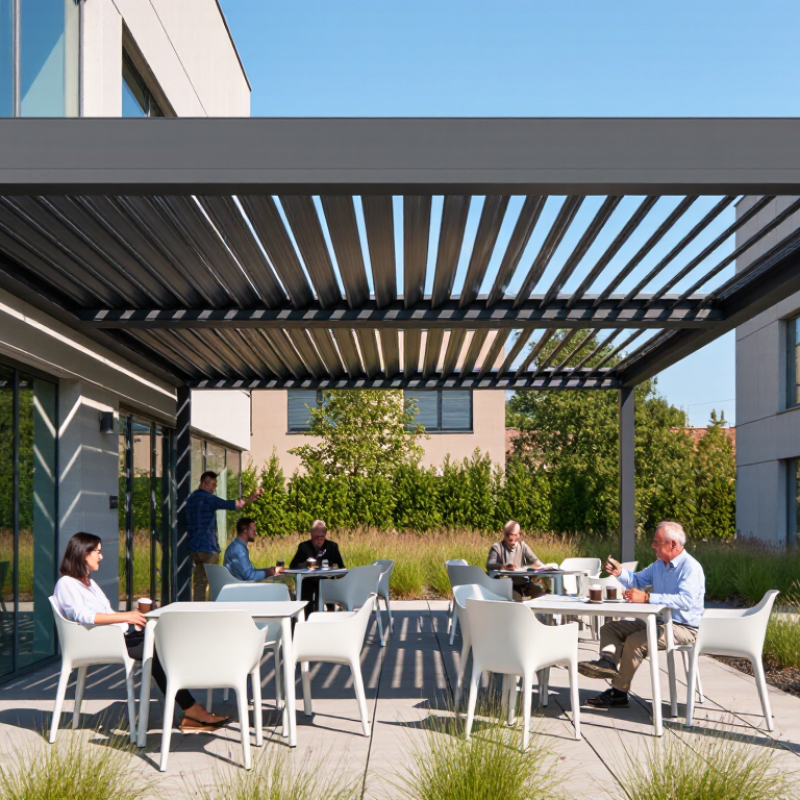
Louvered pergola manufacturers produce outdoor structures with roof blades that rotate to manage sunlight, airflow, and rain. Typical systems combine aluminum or timber frames, adjustable louvers, drainage channels, and manual or motorized controls. Product quality depends on more than appearance. Ask whether the roof drains through the posts, how replacement parts are supplied, and what testing supports the stated wind and water performance. A brochure alone is not proof.
For global buyers, compare frame coatings, blade thickness, motor access, and installation drawings. NOAA’s 2023 U.S. Billion-Dollar Weather and Climate Disasters report recorded 28 disasters, with estimated losses of $92.9 billion. That figure does not measure pergola failures, but it underlines why local exposure matters. Request project-specific structural calculations using applicable loading standards, such as ASCE 7 in the United States. Even experienced buyers can focus too much on blade movement and overlook drainage details.
Tip: Ask for a sample finish, wiring diagram, spare-parts list, and written warranty exclusions. Confirm that local installers can service the motor and seals. A small detail matters: water should exit away from doors and walkways.
Top Louvered Pergola Manufacturers for Global Buyers - Understanding Louvered Pergola Manufacturers and Their Products
| Product or Capability Dimension | Common Manufacturer Offerings | What Global Buyers Should Verify |
|---|---|---|
| Frame and Louver Materials | Aluminum is commonly used for louvered pergola frames and blades because it is relatively lightweight and corrosion-resistant. Some designs may use other metals or combine materials. | Ask for material specifications, alloy or grade details, wall thicknesses, and the finish specification. Confirm suitability for the project’s coastal, humid, or other environmental conditions. |
| Louver Operation | Adjustable louvers are commonly operated by an electric motor; some products use manual controls. Motorized systems allow users to change the angle of the blades to manage sunlight and airflow. | Confirm the control method, power requirements, operating range, manual override availability, and compatibility with any intended building-control system. |
| Rain Management | Many designs direct rainwater through channels in or around the louvers into integrated gutters and downspouts when the roof is closed. | Request installation details, drainage capacity information, and written clarification of weather-performance limits. A louvered roof should not be assumed to be fully waterproof in every condition. |
| Wind and Structural Performance | Structural performance depends on the frame, louver design, dimensions, fixings, installation, and local exposure conditions. Ratings and test methods can differ between products and markets. | Obtain project-relevant engineering information or test documentation. Check applicable local building requirements and confirm the required anchoring and foundation design with a qualified professional. |
| Configuration and Custom Sizing | Manufacturers may offer freestanding or wall-attached configurations, multiple bay layouts, and project-specific dimensions. Available options differ by product system. | Confirm maximum spans, post locations, clearances, allowable configurations, and whether the quoted dimensions are standard or custom. Request dimensioned drawings before production. |
| Surface Finish and Color | Powder-coated finishes are commonly offered for aluminum components, often in a selection of standard colors; custom colors may be available by request. | Ask for the coating specification, color samples, care instructions, and any relevant finish-performance documentation. Verify whether custom finishes affect cost or lead time. |
| Lighting and Accessories | Optional features may include integrated lighting, heaters, screens, sensors, or remote controls, depending on the system. | Check accessory compatibility, electrical requirements, control integration, and whether accessories are included in the quotation or supplied separately. |
| Manufacturing and Documentation | Suppliers may provide product drawings, installation instructions, parts lists, and packaging information. Documentation and support levels vary. | Request current technical documents, installation guidance, spare-parts information, export packaging details, and a clear process for handling defects or missing components. |
| Warranty and After-Sales Support | Warranty coverage and service arrangements vary by supplier, component, destination, and intended use. | Review warranty duration, exclusions, claim procedures, replacement-part availability, and who is responsible for local installation and service. |
| International Orders and Compliance | Export arrangements can involve shipment planning, customs documentation, and market-specific product or electrical requirements. | Confirm the delivery terms, shipment responsibilities, required certificates or declarations for the destination market, and who handles import duties and customs clearance. |
Product features, ratings, dimensions, certifications, and warranty terms vary by manufacturer and model. Verify specifications and compliance documentation for the exact product and project before ordering.